Iranian Journal of Pathology
The Iranian Journal of Pathology (Iran J Pathol) uses peer review to support the quality, integrity, validity, and relevance of manuscripts submitted to the journal. The peer-review process is intended to assist editors in making fair and evidence-based editorial decisions and to help authors improve the clarity, accuracy, and scientific value of their work.
Manuscripts are evaluated according to the journal’s aims and scope, scientific originality, methodological soundness, ethical compliance, quality of reporting, relevance to pathology and related biomedical sciences, and contribution to the scholarly literature.
The journal follows a double-blind peer-review process, in which the identities of authors and reviewers are concealed during peer review where possible. Authors should remove identifying information from the main manuscript file, and reviewers should not attempt to identify the authors.
After submission, manuscripts are checked by the editorial office for completeness, formatting, required declarations, article type, ethical statements, and basic compliance with journal requirements.
Manuscripts may be returned to authors before peer review if they are incomplete, outside the journal’s scope, incorrectly formatted, missing required ethical or authorship declarations, or written in a manner that prevents proper editorial assessment.
Manuscripts that pass the initial technical check are assessed by the editor-in-chief, an associate editor, or an assigned academic editor. The editor evaluates whether the manuscript is suitable for external peer review.
A manuscript may be rejected without external review if it is outside the journal’s scope, lacks sufficient scientific quality or originality, has major methodological or ethical problems, or is unlikely to meet the journal’s editorial standards.
Manuscripts selected for peer review are usually evaluated by at least two qualified reviewers with relevant expertise. Reviewers are selected based on subject knowledge, methodological expertise, publication record, previous reviewing experience, absence of conflicts of interest, and ability to provide a timely and constructive assessment.
Reviewers are asked to evaluate the manuscript’s originality, scientific importance, methodology, statistical analysis, ethical compliance, clarity of reporting, interpretation of results, references, figures, tables, and relevance to the journal’s scope.
Reviewers are expected to accept review invitations only when they have the necessary expertise and can complete the review within the requested timeframe. They must respect confidentiality, declare conflicts of interest, provide objective and constructive comments, and avoid personal, hostile, discriminatory, or unsupported remarks.
Reviewers must not use unpublished information obtained during peer review for personal, professional, financial, or research advantage. Detailed reviewer expectations are provided on the journal’s Guidelines for Reviewers page.
Reviewer comments and recommendations are advisory. Final decisions are made by the editor-in-chief or responsible editor based on peer-review reports, editorial assessment, journal scope, scientific quality, ethical compliance, and the manuscript’s contribution to the field.
Editorial decisions may include:
When revision is requested, authors should submit a revised manuscript and a detailed response to reviewers. The response should address each reviewer and editor comment point by point and indicate where changes have been made in the manuscript.
Revised manuscripts may be evaluated by the editor, returned to the original reviewers, or sent to additional reviewers when necessary. Failure to respond adequately to reviewer or editorial comments may result in rejection.
The journal aims to complete peer review in a timely manner. The duration of review may vary depending on reviewer availability, manuscript complexity, revision requirements, and editorial workload. Authors may contact the editorial office if a manuscript has remained under review for an unusually long period.
Based on 199 articles published from January 2024 to October 2026, the median time from receipt of the manuscript to acceptance was 108 days (interquartile range 67 to 162 days). The median time from acceptance to online publication was 81 days (55 to 126 days), and the median time from receipt to online publication was 211 days (158 to 264 days). These figures include time spent by authors on revision. They will be updated every year.
All manuscripts, reviewer reports, editorial correspondence, and unpublished data are treated as confidential. Editors and reviewers must not disclose or use unpublished information obtained during the review process for personal advantage.
Editors and reviewers must declare conflicts of interest and recuse themselves from handling or reviewing manuscripts when a conflict may affect, or appear to affect, impartial judgment.
If reviewers or editors identify possible plagiarism, duplicate publication, data fabrication or falsification, image manipulation, inappropriate authorship, undisclosed conflicts of interest, lack of ethical approval, or other publication ethics concerns, the journal will evaluate the matter according to its publication ethics policies and relevant editorial guidance.
Editorial decisions are based on scientific merit, methodological quality, ethical compliance, relevance to the journal’s scope, peer-review evaluation, and editorial judgment. Article processing charges, optional post-acceptance production services, institutional affiliations, nationality, political considerations, or commercial interests do not influence peer review or editorial decisions.
Authors may appeal editorial decisions or submit complaints through the journal’s complaints and appeals procedure. Appeals must be evidence-based and should explain why the authors believe that a decision was affected by a factual error, procedural concern, or misunderstanding. Disagreement with reviewer opinion alone is usually not sufficient grounds for appeal. Complaints and appeals are sent to the editorial office at [email protected]. The procedure and response times are described on the Publication Ethics page.
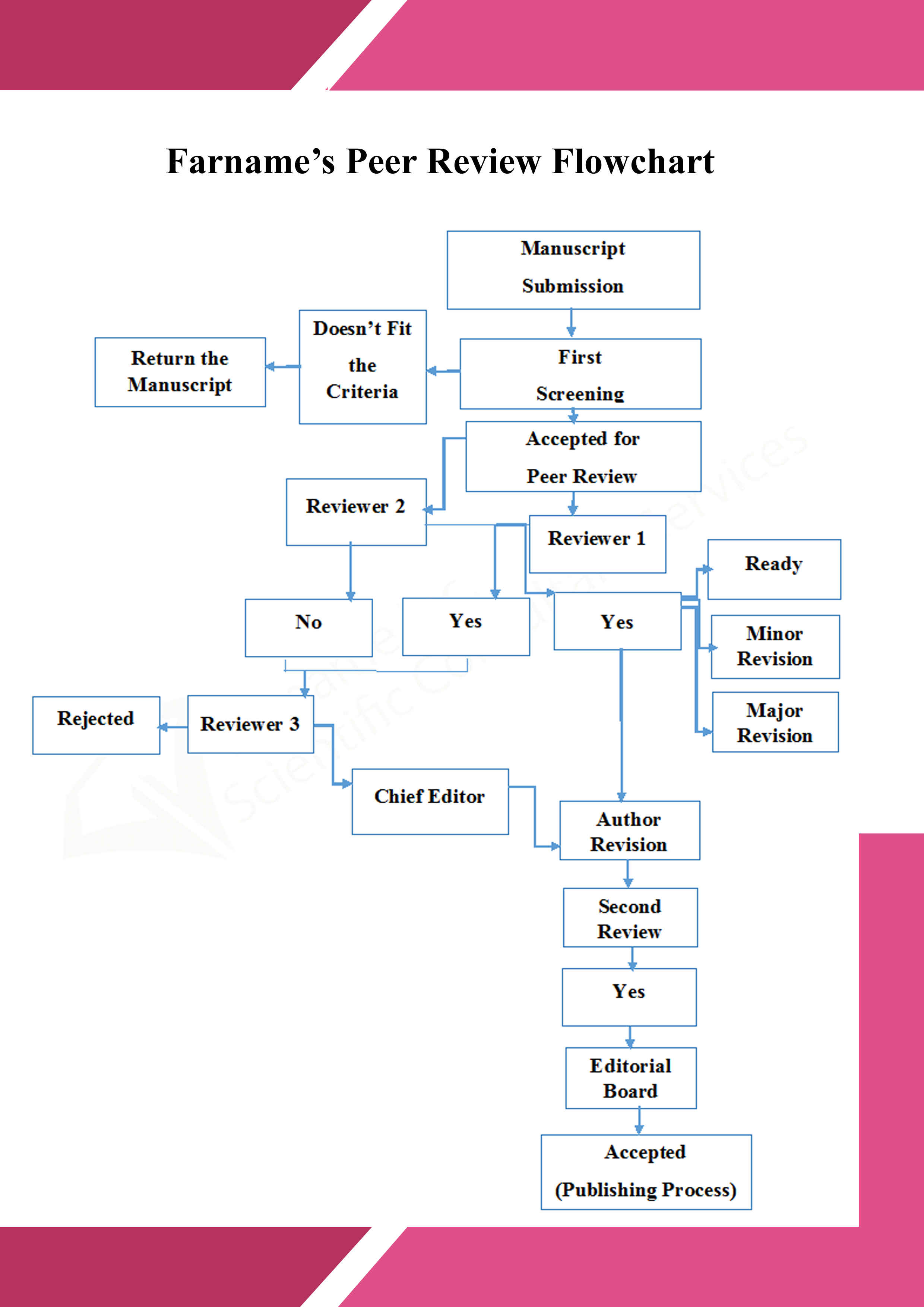
The following flowchart summarizes the general editorial and peer-review workflow of the journal.
Authors, reviewers, and editors are encouraged to consult the journal’s Author Guidelines, Guidelines for Reviewers, and Publication Ethics pages. The Publication Ethics page covers conflicts of interest, the use of artificial intelligence, corrections and retractions, and complaints and appeals.
